



















We often think about how magnets attract metal objects. They are no less than real-life marvels, especially transformers and how they power our devices. All the devices we use are one of these magnets of magnets we call magnetic permeability. It is a pure concept that is the heart of many majors like electromagnetism, electronics, and material science.
If you think you will get some boring physics lecture out here, don't worry, we will show you what magnetic permeability is in a simple, fun way. So, whether you are a student or just have free time learning something, here you will find how the real world works.
What Is Magnetic Permeability?
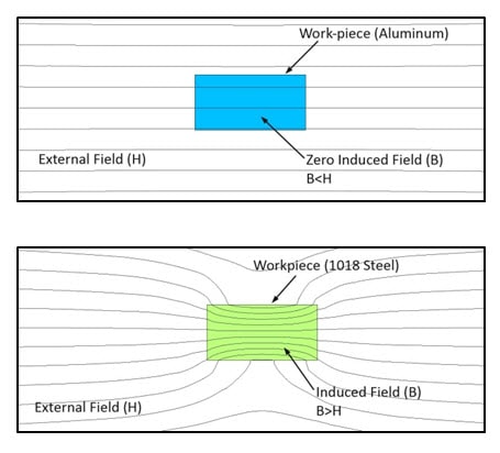
Magnetic permeability is how easily any material can turn into another magnet or get magnetized. Not to be too much of a physics teacher, but it tells you how anything can conduct magnetic lines of force.
You must be familiar with electric conductivity, which tells how easily electricity passes through any wire. Likewise, magnetic permeability shows how it can turn past a magnetic field through a material.
So now, if you place a material near a magnetic field, what will happen? Any guesses? There will be high permeability only if in the case of how much a material supports that field. If the material is reluctant to go into the field, then less and less will be the permeability.
We hope you know the concept of magnetic permeability for now. Even if you didn't, don't worry. You will know when we start talking about the interval of magnetic permeability.
Examples of Magnetic Permeability
So, let's bring magnetic permeability to life and learn how it works.
Iron Sticking to a Magnet: Let's say, for an instant, there is an Iron nail in one hand and a magnet in the other. When you slowly bring them together, you will feel a force of attraction on your hands where the magnet will attract the Iron nail to itself. Now, this means there is high magnetic permeability, which responds strongly to high magnetic fields.

Wood and Magnets: What about wood? Have you ever encountered wood sticking to a magnet? Of course not. Woods have no magnetic permeability as compared to metals, such as iron or steel.
Note: The best example of magnetic permeability is the Transformer. Transformer cores are made of special steels with the highest permeability, which work perfectly in magnetic fields to accomplish their applications.
So whether a magnet sticks to something or not, it's not about the magnet; it's about whether that something passes magnetic fields through it or not.
What Does Science Say About Magnetic Permeability?
Now, let's come to the scientific perspectives. I promise you it will not be boring at all.
When we talk about the Permeability of something or a material, it is derived from an equation which says:μ=H/B
● Here μ (mu) refers to magnetic permeability.
● B refers to magnetic flux density, which shows how strong magnetic fields are around the material.
● H refers to magnetic field strength, which is the magnetic field applied from the outside and how strong it is.
What is the Difference Between Absolute Permeability and Relative Permeability?
There are two types of permeability.
Absolute Permeability: It is the value of permeability that we use when a specific material is at hand. Its symbol is "μ."
Relative Permeability: Now, talk about relative permeability, which will get a bit tough, but don't worry. It compares the permeability of something in free space; we can say a vacuum has a permeability in terms of the equation:μ0 = 4π × 10^7 H/m
So, the relative permeability will be:μr=μ/μo
If there is a material with μᵣ > 1, it will represent that it has a better magnetic field, which is also called ferromagnetic. If μᵣ < 1, then it will show a weak or less magnetic field, which is known as diamagnetic.
Types of Magnetic Materials Based on Permeability
Now, here is the interval part where you will see everything of interest. Talk about materials, then they respond differently to magnetic fields depending on their permeability. If we break them into different parts, you will know better how they work.
1. Ferromagnetic Materials
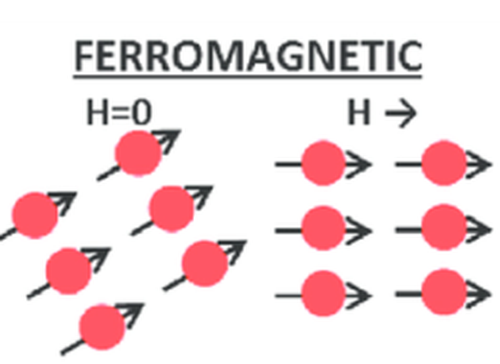
Ferromagnetic materials are very common and have very high relative permeability. Such a type of material strongly attracts in magnetic fields and can even, in fact, adapt to magnetism for a while when the field is removed.
Examples: It includes Iron, Nickel, Cobalt, and more.
2. Paramagnetic Materials

Paramagnetic materials are partially attracted to the magnetic fields rather than strongly. Such material does not maintain or adopt magnetism when the field is removed. Their relative permeability becomes just slightly more than 1.
Examples: Include Aluminum, Platinum, Magnesium, etc.
3. Diamagnetic Materials
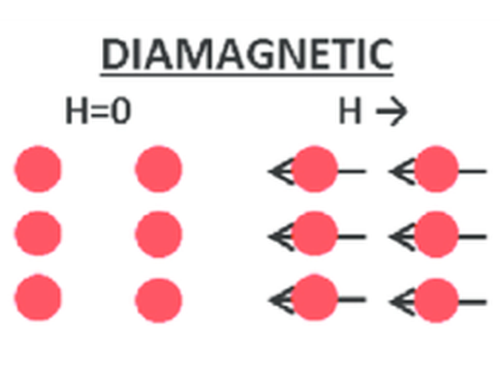
Such a type of material is slightly repelled by the magnetic field rather than being attracted to it. Its relative permeability is slightly less than 1, which explains why it is repelled by magnetic fields.
Examples: Copper, Bismuth, Water, and more.
Importance of Magnetic Permeability in Real Applications
Talking about metameric permeability is not just a lecture in a physics class; it is a literal example of how modern technology works. Here, find out how we use magnetic permeability ineverything we use daily.
Electric Motors and Transformers
Magnetic permeability is used in transformers, and electric motors thoroughly depend on magnetic fields to generate and transfer energy. The materials used in these systems are high in permeability, enabling better energy transfer and, as a result, reducing energy loss and heat loss.
Shielding from External Magnetic Fields
Some engineers use materials with less permeability, such as spacecraft MRI scanners. Such materials are used to protect components from any of the external magnetic fields.
Data Storage Devices
We use magnetic tapes and hard drives; all of these materials are ferromagnetic materials. They are used to store or save data.
Use of Electromagnets
Electromagnets have many uses, such as in cranes and magnetic trans imaging (MRI) scanners. Electromagnetism works on materials that penetrate magnetic fields because of their high permeability.

In addition to these applications, magnetic permeability also plays a key role in industrial magnetic systems. In processes where magnetic fields are used to capture and separate metal particles, the choice of materials with the right permeability directly affects how the magnetic field is guided and how effective the separation becomes.
This is especially important in magnetic separation equipment, where field distribution and material response determine overall performance.
Magnetic Permeability in Magnetic Separation Equipment
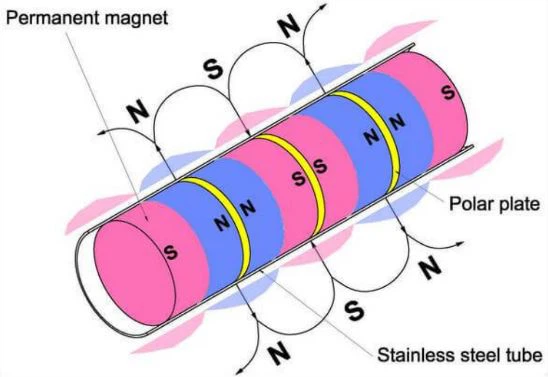
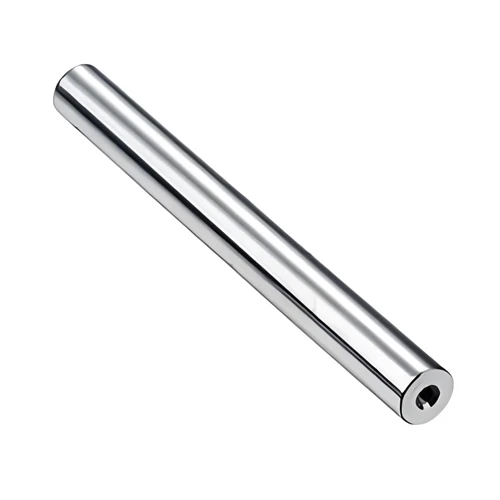
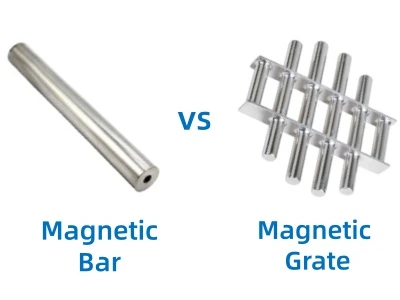
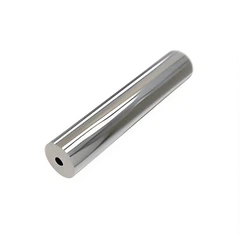
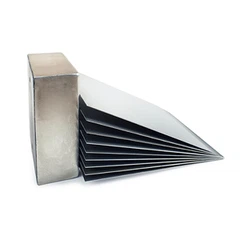
In magnetic rods, permeability plays a role in how the magnetic field is concentrated near the surface, which affects the ability to capture fine ferrous particles in powder or granular materials.
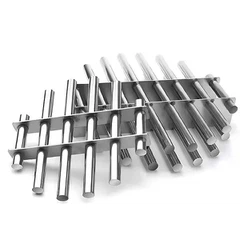
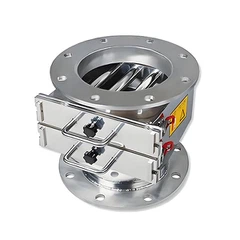
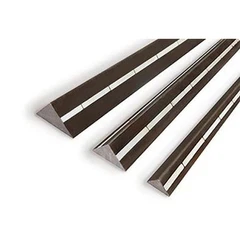
In magnetic grates, the design of the magnetic circuit and the materials used influence how the field is distributed between the bars, helping improve separation efficiency in bulk material flow.
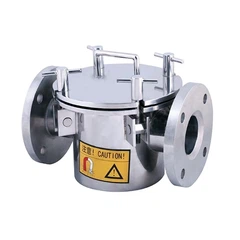
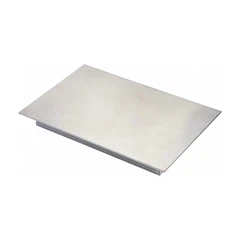
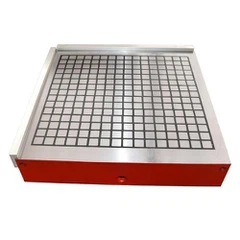
In plate magnets, permeability affects how the magnetic field is directed toward the working surface, making it easier to remove metal contaminants from materials moving across chutes or conveyors.
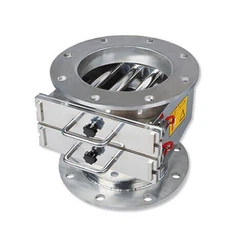
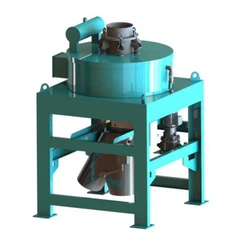
In drum magnetic separators, permeability influences how the magnetic field is arranged across the rotating drum, which affects how particles are attracted, carried, and released during continuous separation.
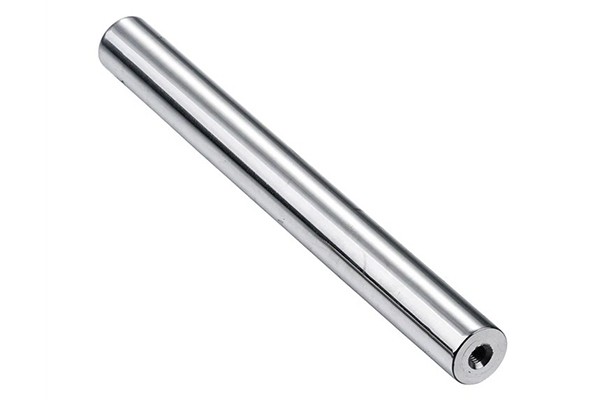
Magnetic Rod
Send Inquiry Now
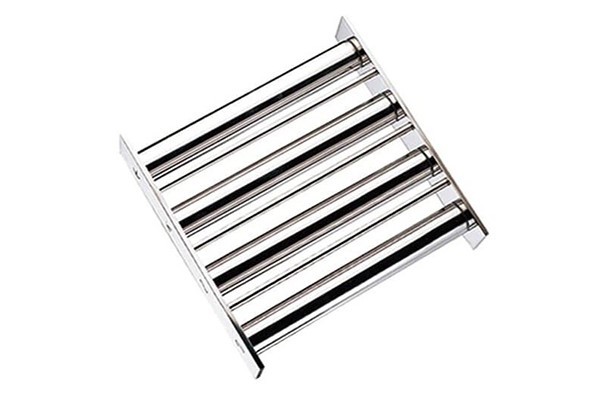
Magnetic Grates
Send Inquiry Now
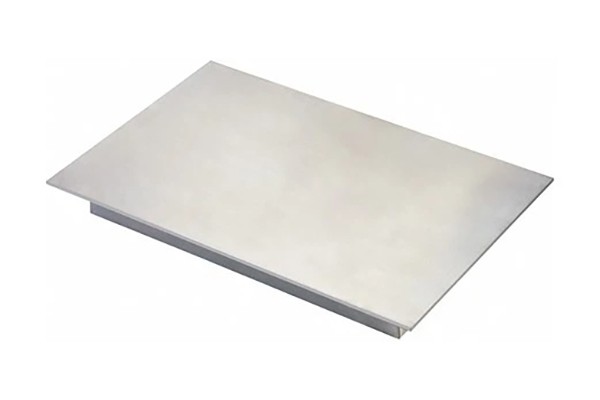
Plate Magnets
Send Inquiry Now
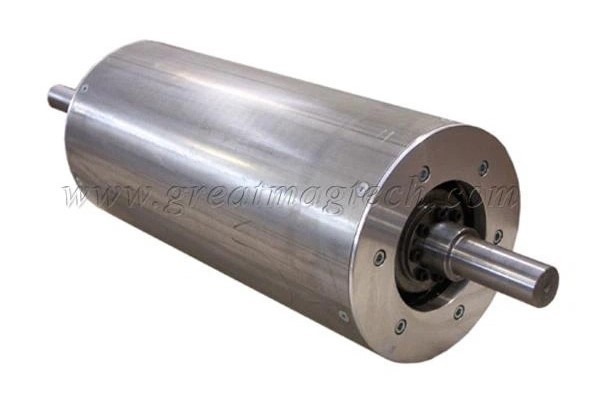
Drum Magnet
Send Inquiry Now
Typical Magnetic Permeability Values of Common Materials
Different materials respond differently to magnetic fields, and this response is often described by relative magnetic permeability. Knowing typical values helps you understand how a material will behave in a magnetic system.
| Material | Relative Permeability (Approx.) | Behavior |
|---|---|---|
| Air | ~1 | Almost no magnetic response |
| Copper / Aluminum | <1 | Slightly repelled by magnetic fields |
| Stainless Steel (304/316) | ~1–1.1 | Very weak response |
| Carbon Steel | 100–1000+ | Strong magnetic response |
| Silicon Steel | 1000–5000 | Used in magnetic cores |
| Ferrite | 200–2000 | Moderate magnetic response |
| Mu-metal | 20,000–100,000+ | Very high permeability, used for shielding |
In practice, materials with higher permeability allow magnetic fields to pass through more easily and concentrate them in specific areas. This is why they are often used in magnetic circuits and separation systems. Materials with low permeability have little interaction with magnetic fields, so they are less effective in applications where magnetic control is required.
How to Choose Materials Based on Magnetic Permeability
When you choose materials for a magnetic system, permeability helps you understand how the magnetic field will behave, but it should not be the only factor you look at. In real applications, the goal is not simply to use the material with the highest permeability, but to match the material to how the system actually works.
If your design needs to guide and concentrate the magnetic field, such as in magnetic circuits or separator components, materials with higher permeability are usually preferred. They help direct the field to the working area and improve how effectively metal particles are captured.
But in many cases, high permeability alone is not enough.
You also need to consider how the material performs under real conditions. For example, stainless steel housings are often used in magnetic rods or grates, even though their permeability is low. This is because they offer corrosion resistance, strength, and stability, which are just as important in production environments.
Temperature is another factor. Some materials lose magnetic performance when exposed to heat, so the working environment can affect your choice. Mechanical strength and wear resistance also matter, especially in systems that run continuously.
In practice, material selection is always a balance. Permeability tells you how the material interacts with the magnetic field, but durability, environment, and system design decide whether it is the right choice for your application.
Permeability is Not Always Constant
Now, there is another twist you need to understand. Certain factors can cause magnetic permeability to charge. To understand it better, let me know what these factors are.
Magnetic Saturation
There is a difference in saturation: how much a material can take in magnetic flux. If iron, which is a highly permeable material, is applied to a magnetic field, it will get saturated, but it will not take in magnetic flux.
It is like a sponge when soaked in water. How much can it hold? As much as it can.
Temperature Differences
Temperature affects permeability.
● If you heat ferromagnetic materials, then their Permeability can decrease.
● Likewise, at the Curie temperature, the end will lose all its magnetic properties and no longer react to the magnetic field.
Frequency Difference
If something uses an alternating current, like transformers, permeability can have different frequencies. Such cases lead to some core losses that engineers are still working to manage.
Fun Facts About Magnetic Permeability
Now, enough of the equations and all the robotic science, let us introduce you to the fun part of magnetic permeability.
● If we talk about a vacuum, then it has a baseline permeability. This means empty spaces let magnetic fields go through, making permeability a universal constant.
● Some materials float in a magnetic field. Like bismuth and graphite, they can levitate in strong magnetic fields because of diamagnetism.
● Ever wondered how they shield spacecraft or lab instruments from Earth's magnetic field? They use Mu-Metals, which have an extremely high permeability, to maintain their balance and save them from the Earth's magnetic field.
● Earth's magnetic field is generated by a giant ferromagnetic ball in the core of Earth.
FAQs
Q: Is higher magnetic permeability always better?
A: Not always. Higher permeability helps guide and concentrate the magnetic field, but in real systems, you also need to consider strength, corrosion resistance, and operating conditions. In some cases, a lower permeability material is still the better choice overall.
Q: Why are stainless steel housings used if they have low permeability?
A: Stainless steel is often used because it is strong, corrosion-resistant, and easy to clean. Even though its permeability is low, it protects the magnetic core and works well in harsh or hygienic environments.
Q: Is permeability the same as magnetic strength?
A: No. Permeability describes how a material responds to a magnetic field, while magnetic strength usually refers to how strong the magnet itself is. Both are important, but they are not the same.
Q: Can materials be selected based only on permeability values?
A: No. Permeability is just one factor. You also need to consider temperature, environment, mechanical properties, and how the material fits into the overall system design.
Q: Can magnetic permeability change during use?
A: Yes. Temperature, mechanical stress, and long-term operation can affect how a material behaves. In high-temperature or high-load conditions, performance may change over time.
Conclusion
Magnetic permeability is a useful way to understand how materials interact with a magnetic field, but its real value shows up when you apply it in actual systems. From guiding magnetic fields to improving separation performance, the right material choice can make a noticeable difference in how stable and effective your process is.
What matters is not just the number itself. It is how that number fits your working conditions.
In many cases, you are balancing permeability with other factors like durability, temperature, and environment. A material that looks ideal on paper may not perform the same way in production.
If your application involves magnetic separation or magnetic components, taking permeability into account can help you make more reliable decisions. At Great Magtech, different magnetic solutions are designed to match real operating conditions, so the system works as expected over time.