









Your slurry just passed a 50 µm filter. That doesn't mean it's clean.
A mechanical filter sorts particles by size. It can't tell a graphite agglomerate from a stainless-steel wear particle. And the iron fines that hurt a lithium-ion cell most are usually small enough to pass straight through the screen.
That's the gap a magnetic filter for battery slurry is built to close.
What Is a Magnetic Filter for Battery Slurry?
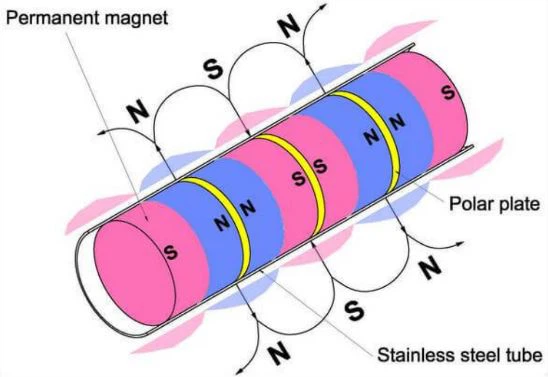
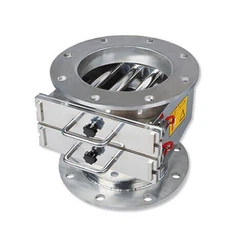
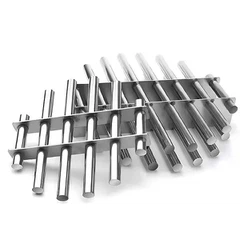
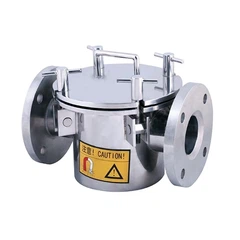
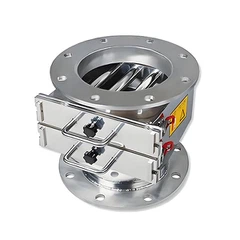
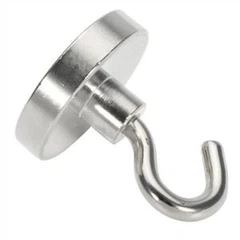
A magnetic filter is a housing with magnet rods inside it. Product flows through. Magnetic particles stick to the rods. Everything else carries on.
A magnetic filter for battery slurry is the same device built for a harder duty: higher viscosity, abrasive solids, solvent-rated seals, and a contamination target measured in ppm rather than in visible specks.
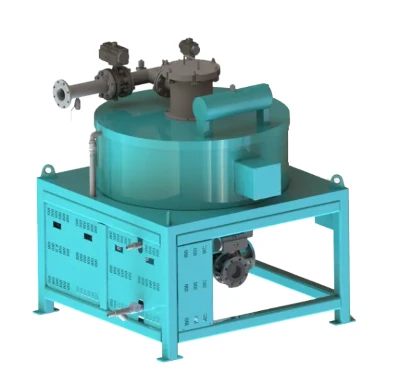
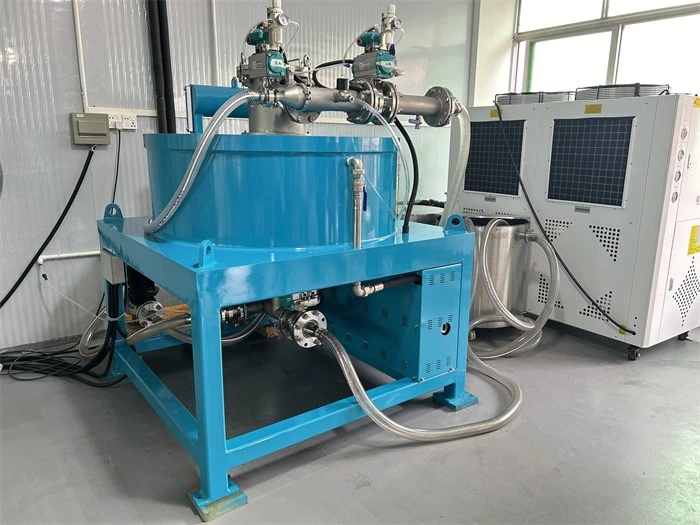
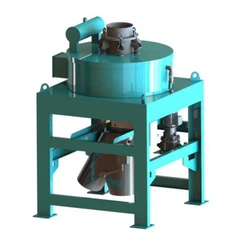
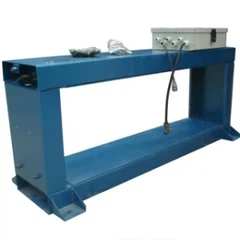
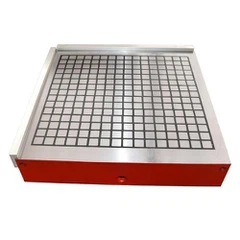
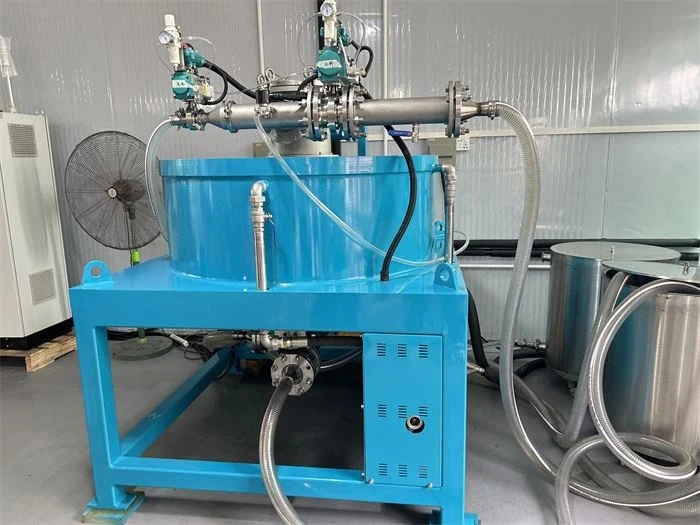
Wet Electromagnetic Separator
What It Removes From Electrode Slurry
In an electrode slurry line, typical contaminants include:
• Iron fines and rust: introduced with active materials, conductive additives, or upstream handling equipment
• Magnetic iron oxides: present in raw materials or generated during processing
• Stainless-steel wear debris: from mixer blades, pump components, valves, and pipe elbows. Although grades such as 316L are generally considered non-magnetic, machining, wear, and deformation can make some particles more magnetically responsive
• Fine or weakly magnetic particles: that may pass through a mechanical screen but can still be captured by a sufficiently strong magnetic field and gradient
What it can't remove
A magnetic filter removes particles, not dissolved iron ions. Once iron has gone into solution, there is nothing for the field to hold, and the problem becomes chemical rather than magnetic. This is the main argument for catching iron early, while it is still a particle.
Magnetic Filter vs Mechanical Filter
Plenty of slurry specs list "filtration" as a single line item. That's where the trouble starts, because the two devices sitting on that line are answering completely different questions.
A mechanical filter asks how big a particle is. A magnetic filter asks whether a magnet can move it. A 30 µm iron flake slips through the first and gets caught by the second. A 200 µm binder gel does the opposite.
| Mechanical filter | Magnetic filter | |
| Sorts by | Particle size | Magnetic response |
| Targets | Agglomerates, gels, dried skins, oversize solids | Iron fines, magnetic oxides, magnetic wear debris |
| Size reach | Limited by the element rating | Catches magnetic fines well below any screen rating |
| Pressure drop | Climbs as the element loads | Stays low; depends on flow path, not on loading |
| How it fails | Blinding, bypass, torn element | Surface saturation, fouled rods, quiet efficiency loss |
| Real job | Particle-size control | Ferrous contamination control |
Why Trace Iron Matters in a Lithium-Ion Cell
Where the Iron Comes From
Iron enters at four points, and they split into two groups that matter for different reasons.
Before the slurry exists. Cathode and anode powders, conductive carbon, and binder all carry a small ferrous load before you open the bag. This load is the earliest of the four, and the easiest to remove - because it's still in the material, not yet in a moving process. That makes it a placement question, not a filter question: you decide where incoming material gets checked, and the answer doesn't depend on your line's wear behavior.
Once the slurry is moving. The other three sources are all created by the process itself, and they behave the same way - they shed continuously and you can't inspect them out.
• Your mixer makes some of it. High-shear dispersion is abrasive by design. Blades, discs and tank walls wear, and what wears off goes into the batch.
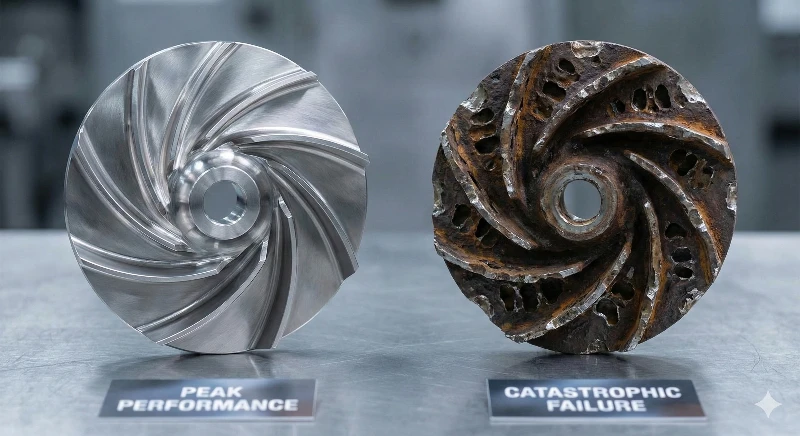
• Your pumps and pipework add more. Rotors, seal faces, valve seats, elbows where the slurry changes direction hardest - all of it sheds.
• Transfer adds the rest. Dried slurry skins flake off tank walls and hose interiors, and anything they trapped comes along with them.
The damage a particle does is mechanical at first, electrochemical later - and only the second one is why anyone specifies iron in ppm.
The fast failure: coating and electrode defects
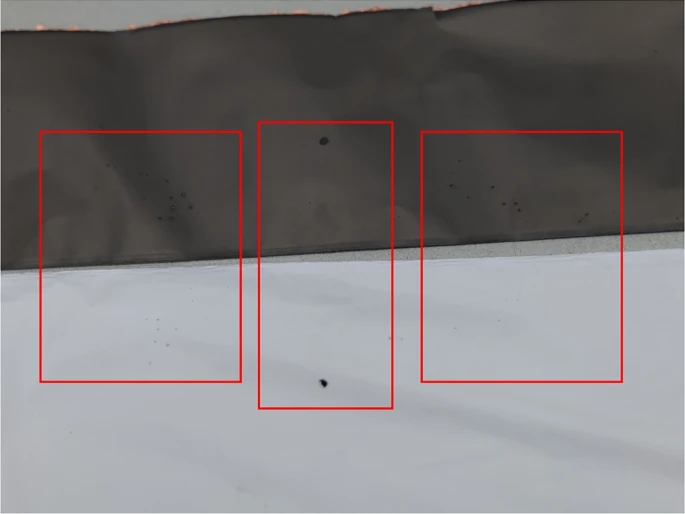
This one is mechanical. A hard particle sitting in a wet coating drags behind the doctor blade, leaves a scratch or a patch of bare foil, or dries into a bump that the calender then presses into the layers above it. You catch this on the line, in scrap rate, within hours.
The slow failure: dissolution, migration and internal shorts
This one is electrochemical. Charge the cell and a metal particle on the cathode side starts to dissolve. The ions migrate across to the anode and plate out. Over repeated cycles those deposits grow, push into the separator pores, and eventually bridge the two electrodes - showing up first as elevated self-discharge, later as a real internal short.
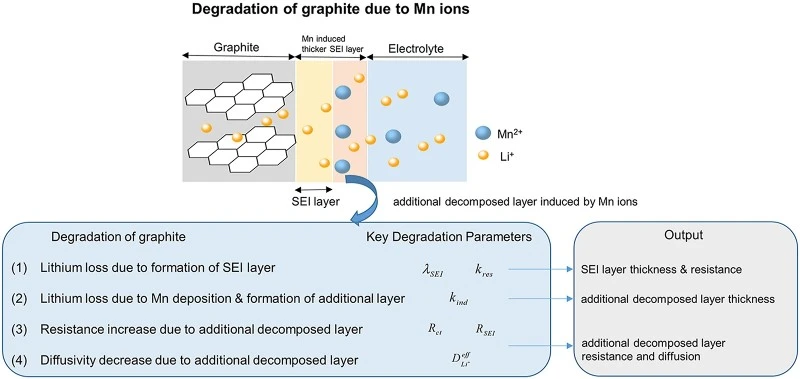
There's a quieter cost alongside it. Transition metal ions that reach the graphite anode change the SEI that forms there - thicker, more resistive, consuming lithium each time it rebuilds. Reviews of transition metal dissolution and deposition tie the same process to capacity and power fade. Impedance climbs. Capacity drops.
None of this makes every contaminated batch a safety event. But metallic particles do sit near the top of the list of manufacturing defects that can seed early thermal runaway. Cell makers specify magnetic foreign matter in incoming material at the ppm level or below, with the exact limit set per customer and per material - and that number is rarely open to discussion.
Permanent vs Electromagnetic: Which Fits Your Line
Only two kinds of magnetic separator really earn a place on a slurry line. They aren't competing versions of the same machine - they sit at different points on a cost, control and complexity curve.
Permanent magnetic liquid traps
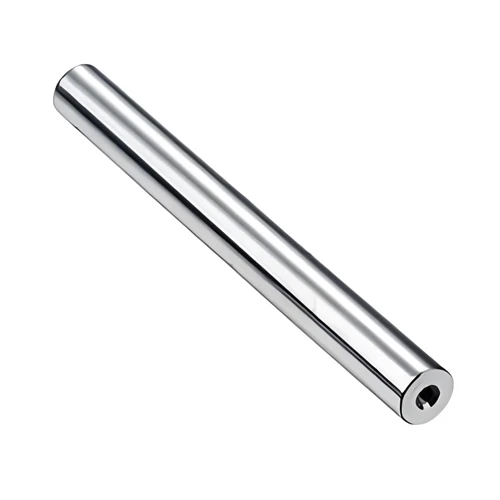
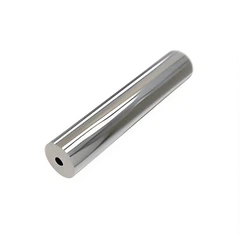
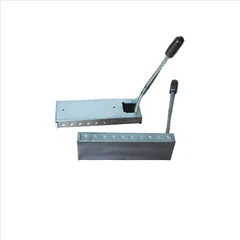
Rare-earth rods in a stainless housing, and nothing else. No power supply, no controls, nothing to fail electrically.
Surface field runs around 13,000 Gs (1.3 T). That's strong - but it's fixed. Every batch gets the same field whether it needs it or not.
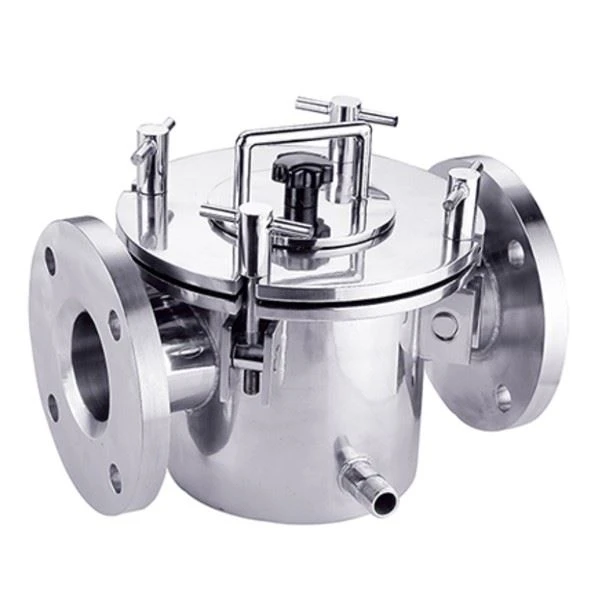
Check the practical limits early. Typical units are built in SS304, 316 or 316L and rated to roughly 80 °C and 1 MPa. Cleaning means stopping the line, opening the housing and drawing the rods out so the captured iron lets go.
Good fit when viscosity is moderate, batches are consistent, and you want the simplest thing that works. See a 13,000 Gs liquid trap built for battery raw materials.
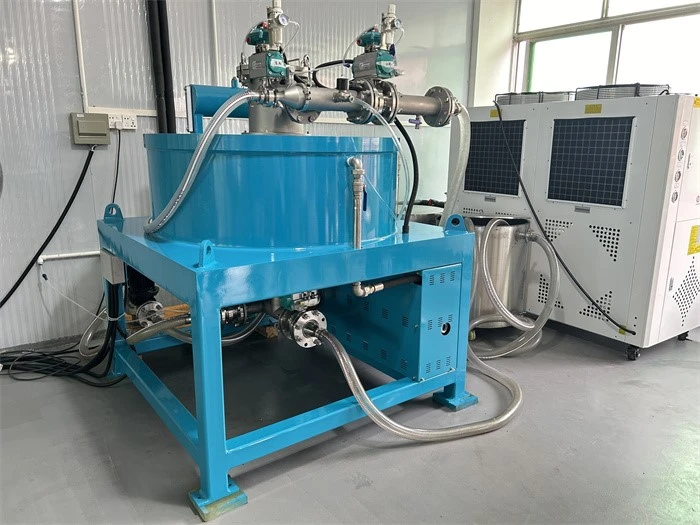
Wet high-gradient electromagnetic separation
Here a coil generates the field, and you can turn it up or down. Background field typically runs 3,500 to 6,000 Gs (0.35–0.6 T), with the working field inside the matrix reaching 14,000 to 24,000 Gs (1.4–2.4 T) depending on model.
That distinction trips people up. A 6,000 Gs background looks weaker than a 13,000 Gs permanent rod - until you notice the two numbers aren't measuring the same thing. The matrix concentrates the field well above the background figure, and it's the gradient inside that matrix doing the catching.
You pay for it in power, roughly 11 to 24 kW, and in floor space. Throughput lands around 5 to 25 m³/h.
Good fit when viscosity is high, when the contamination is weakly magnetic, or when different formulations need different field strengths out of one machine. See wet electromagnetic separators for lithium compound slurry.
Eight Factors That Decide Whether It Works on Your Line
Field strength is only one of them, and rarely the deciding one.
1. Field strength - and where it was measured. Rod surface, coil background and matrix working field are three different numbers. Comparing one against another tells you nothing.
2. Gradient and matrix design. Field strength pulls; gradient is what grabs. A tightly packed matrix catches finer particles, but non-magnetic solids can bridge between the elements and blind it.
3. Viscosity and flow rate. Viscosity at process temperature, not at ambient, is the resistance every captured particle in your slurry has to fight through. And real flow, not pump rating, sets how much slurry the field has to deal with.
4. Residence time. A particle needs time in the field to reach the collecting surface. Twice the flow through the same housing means half the time, and capture falls with it.
5. Wetted materials, seals and area classification. SS316L is the usual baseline, but seals decide more - NMP attacks elastomers that handle water-based slurry perfectly well. Temperature and pressure ceilings apply to your worst case, not your normal one. And explosion rating depends on how your plant classifies that area, not on the solvent alone.
6. Cleaning and changeover. Cleaning that means opening the housing means stopping the line, and a long stop gets postponed. A postponed clean is a saturated filter running blind.
7. Dead volume and carryover. Slurry held inside the unit is lost at changeover, and whatever doesn't flush out follows you into the next formulation.
8. Sampling ports. Without a sample point before and after the unit, there's no way to verify it still works. Retrofitting ports into a live slurry line costs far more than specifying them up front.
Where to Install It in the Slurry Line
There's no single correct position. A workable default looks like this:
Mixing / dispersion → coarse or pre-filtration → magnetic separation → final fine filtration → buffer tank → coating
The exact order depends on particle loading, how much ferrous contamination you're carrying, your filter ratings, viscosity, and which piece of equipment you're most trying to protect.
Or before the slurry stage entirely
If most of your iron arrives with the raw powder, the cheapest place to catch it is before mixing. Once it's in slurry, a magnetic particle has to physically travel through the mix to reach the magnet - and a cathode slurry running thousands of centipoise fights that movement the whole way. Same particle, much harder catch.
A dry-stage magnetic separator on the powder feed does the easy work first, and leaves the wet unit downstream to handle what the mixer and pumps generate.
After mixing, before coating
That's the window, and both edges of it matter.Too early, and the mixer keeps shedding wear debris downstream of the one device that could have caught it. Too late - right at the coating head - and you've left no buffer volume to absorb a pressure upset, while every leak or maintenance event now lands on the most sensitive part of the line.
Before or after mechanical filtration?
Both orders are in use, and each has a reason behind it.
Magnetic first protects the mechanical element. Hard ferrous particles are what score screens and tear fine elements. Remove them and the element downstream lasts longer.
Mechanical first protects the magnet. If your slurry carries a heavy load of agglomerates and dried skins, that material coats the magnetic rods and blocks the field before any iron gets near it.
Cleaning and Proving It Still Works
A magnetic filter doesn't announce when it stops working. That shapes both how you clean it and how you check it.
When to clean it
Not on a fixed hour count alone. Contamination loading shifts with raw material lot, with formulation, with how worn your mixer is this month.
Pressure drop isn't a reliable trigger either. A magnetic unit loads up on the rod surfaces without necessarily restricting flow, so a saturated filter can read completely normal on a gauge.
What works is a validated interval - strip the unit at several different run lengths, weigh and inspect what comes off, then set the schedule against real loading. Revisit it whenever the formulation or the supplier changes.
How to tell it's still working
Sample before and after the unit. That's the only direct measurement, and it's why those ports belong in the original specification.
How to verify after cleaning
Captured iron doesn't always release cleanly, especially out of high-binder slurry. A rod that looks clean can still carry a film sitting between the magnet and the next particle.
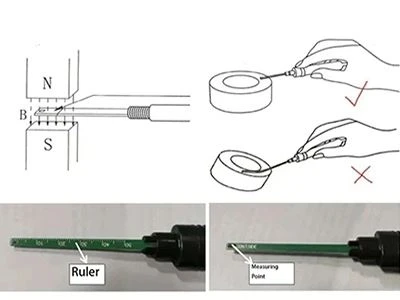
Check the field with a gaussmeter after cleaning, not only at commissioning. Permanent rods lose strength slowly through heat, impact and age. Electromagnetic units are only ever as good as the power supply feeding them. Either way, a number in a log beats an assumption.
Six Questions to Ask Before You Order
Send these to the supplier in writing. The answers tell you more than a datasheet does.
• Field strength - at the rod surface, as coil background, or inside the matrix? Quote every figure from the same point.
• What is the viscosity at process temperature, the real flow rate, and the residence time through the housing?
• Are the seals rated for our solvent, not just the housing - NMP or water-based?
• What does cleaning involve, and how long does the line stop for?
• Are sample ports included before and after the unit?
• How much slurry stays inside the unit at changeover?
Conclusion
Mechanical filters catch agglomerates, gels and dried skins. Magnetic filters catch iron fines and magnetic wear debris. Neither covers the other, and a battery slurry line needs both.
Which magnet depends on the line. Moderate viscosity and consistent batches: a permanent liquid trap at around 13,000 Gs, no power required. Thick slurry, weakly magnetic contamination or changing formulations: a wet electromagnetic unit. Iron arriving with the raw powder: catch it dry, before the mixer.
Whatever you install only counts if you can show it's still working - sample ports before and after, a validated cleaning interval, a gaussmeter reading written down. Without those, you have a housing full of magnets and no idea what it's catching.
FAQ
Q: Does a magnetic filter replace a mechanical filter in battery slurry?
A: No. The two operate on different principles - one by particle size, one by magnetic response. A mechanical filter passes iron fines smaller than its rating, and a magnetic filter passes large non-magnetic agglomerates. Most battery slurry lines run both.
Q: Does a magnetic filter remove dissolved iron ions from battery slurry?
A: No. Magnetic separation only acts on particles that respond to a magnetic field. Once iron has gone into solution, there is nothing for the magnet to hold, and removal becomes a chemical or ion-exchange problem. That's why iron is best captured as a particle, as early in the process as possible.
Q: Permanent or electromagnetic separator for battery slurry - which one?
A: Permanent units give a fixed field of around 13,000 Gs at the rod surface with no power draw and no controls, which suits consistent batches at moderate viscosity. Wet electromagnetic units run an adjustable background field of roughly 3,500–6,000 Gs, with the working field inside the matrix reaching 14,000–24,000 Gs - better for high-viscosity slurry, weakly magnetic contamination, or lines that switch formulations. The trade-off is 11–24 kW of power and more floor space.
Q: Can a magnetic filter handle high-viscosity NMP-based cathode slurry?
A: Yes, but viscosity works against capture. A magnetic particle has to travel through the slurry to reach the collecting surface, and thick slurry resists that movement the whole way. High-viscosity lines need enough residence time and usually a high-gradient matrix rather than plain rods. Seals also have to be rated for NMP, which attacks elastomers that handle water-based slurry without trouble.
Q: Should iron be removed from the powder or from the slurry?
A: Follow the source. If most of your iron comes in with the raw material, remove it at the dry powder stage - capture is easier and cheaper before mixing. If most of it is wear debris from mixers, pumps and pipework, that iron doesn't exist yet at the powder stage, so separation has to sit downstream of the equipment producing it. Lines that have both problems end up with both stages.