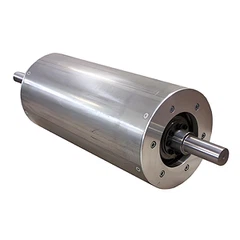







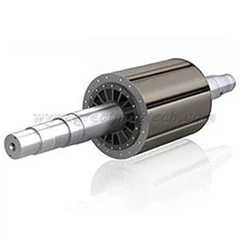




Choosing the wrong magnetic pulley can lead to poor metal separation, installation problems, or unexpected conveyor downtime. A stronger magnet alone won't solve these issues. You also need to consider your conveyor size, belt speed, material conditions, and mechanical load.
So, how do you choose a magnetic pulley that fits your conveyor and removes ferrous metal effectively?
If you're replacing an existing head pulley or designing a new conveyor, you need to check more than magnetic strength. Your pulley must fit the belt, handle the operating load, and separate metal without mixing it back into the material. You'll also learn how to compare specifications and choose a suitable magnetic pulley for your conveyor system.
Check Your Conveyor and Material Conditions
Before choosing a magnetic pulley, you need to know how your conveyor operates and what materials it handles. These details affect how well the pulley fits your system and captures ferrous metal.
Conveyor Operating Conditions
- Belt width and thickness: Check your conveyor belt dimensions to help determine the required pulley size.
- Belt speed: Record the operating speed, as it affects how materials move through the magnetic separation area.
- Material throughput: Know how much material your conveyor handles per hour and whether the flow is steady or uneven.

Material and Metal Contaminants
- Material type: Identify whether you handle grains, minerals, plastic, wood chips, or other bulk materials.
- Particle size and layer thickness: Thick material layers can make it harder for the magnetic field to reach buried metal.
- Metal contaminants: Check the size, shape, and type of metal you need to remove. Small iron particles and large steel pieces may require different magnetic configurations.
Working Environment
Consider the temperature, moisture, dust, and abrasive conditions around your conveyor. These factors can affect the pulley's material selection and long-term performance.
Once you have these details, you can determine the pulley dimensions and mechanical requirements that fit your conveyor.
Choose the Right Pulley Size, Shaft, and Load Capacity
Your magnetic pulley must fit your conveyor and handle the forces placed on it during operation. Even if the magnetic strength meets your needs, the wrong pulley size or shaft design can cause belt tracking problems, bearing wear, or equipment failure.
Focus on three key areas: pulley dimensions, shaft and bearing compatibility, and operating load.
Pulley Diameter and Face Width
Pulley diameter affects how your conveyor belt bends around the pulley. If the diameter is too small, the belt may bend beyond its recommended limit, leading to premature wear or damage.
Check the minimum pulley diameter recommended by your belt manufacturer. If you're replacing an existing head pulley, compare its diameter with the new magnetic pulley.
Face width is the usable width of the pulley surface. It should accommodate your conveyor belt with enough allowance for proper belt tracking. A face that is too narrow may leave the belt edges unsupported.
For both measurements, use your existing conveyor specifications rather than choosing a larger pulley simply for extra capacity.
Shaft and Bearing Dimensions
Your magnetic pulley shaft must fit the conveyor's bearing supports and drive system.
Check these dimensions before selecting a model:
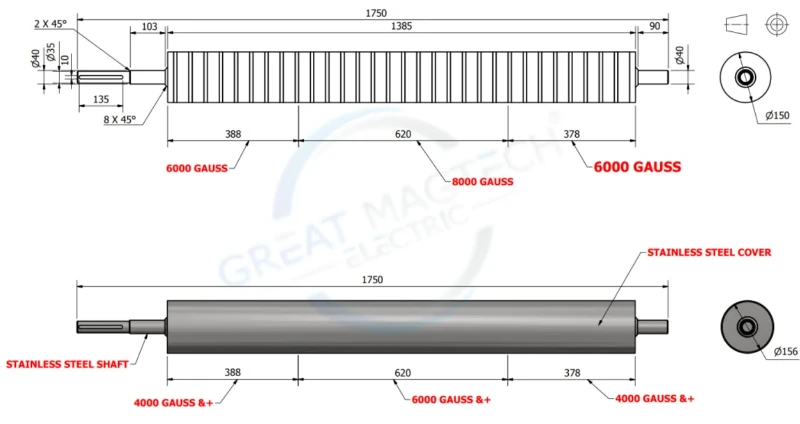
- Shaft diameter: Must withstand the expected load and fit the selected bearings.
- Shaft length: Must provide enough space for bearings and drive connections.
- Bearing center distance: Must match the conveyor frame or allow for suitable mounting changes.
- Shaft connections: Check the keyway, coupling, or other drive connection if your pulley is powered.
If you're replacing an existing head pulley, use the original shaft drawing to compare dimensions. Matching the outside diameter alone does not guarantee that the new pulley will fit.
Belt Tension, Wrap Angle, and Operating Speed
A magnetic head pulley also works as part of your conveyor's mechanical system. You need to confirm that it can handle normal operating loads.
- Belt tension: The pulley and shaft must withstand the forces from the conveyor belt, including the required drive loads.
- Wrap angle: The angle of belt contact affects traction and power transfer when the pulley is driven.
- Operating speed: Confirm that the pulley, shaft, and bearings can operate at your required speed.
- Continuous operation: If your conveyor runs for long periods, check that the pulley assembly is suitable for that duty.
For a driven head pulley, shaft torque and belt tension are especially important. Your supplier may need these details to confirm the mechanical design.
A pulley that matches your conveyor dimensions is only the starting point. Its shaft, bearings, and load capacity must also suit your equipment before you can finalize the selection.
Check the Installation Space and Discharge Layout
Even with the right pulley size and magnetic strength, poor installation or discharge design can reduce separation efficiency. You need enough space for the magnetic head pulley to operate and for captured metal to separate from the main material flow.
Magnetic Pulley Installation Position
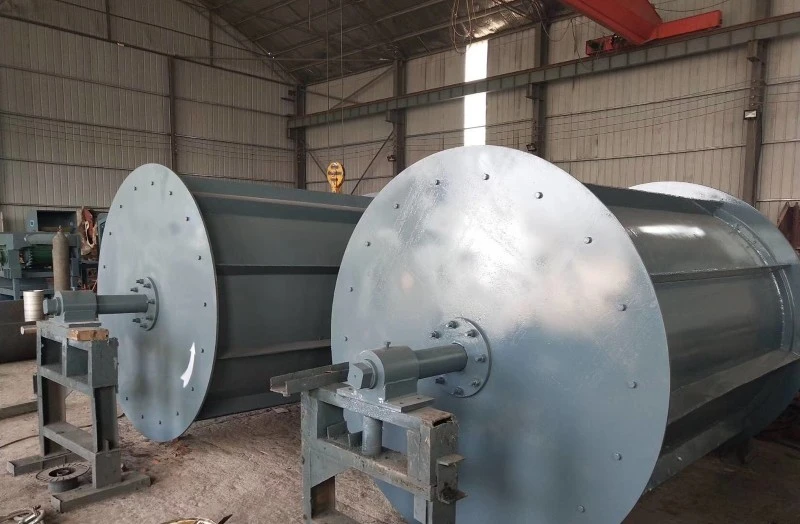
A magnetic pulley is usually installed at the head of your conveyor, where materials leave the belt.
Before installation, check the available space around the conveyor head. Make sure the pulley fits within the existing frame and does not interfere with nearby guards, chutes, or other equipment.
You should also leave enough room to inspect and maintain the pulley without removing major conveyor components.
Material and Ferrous Metal Discharge
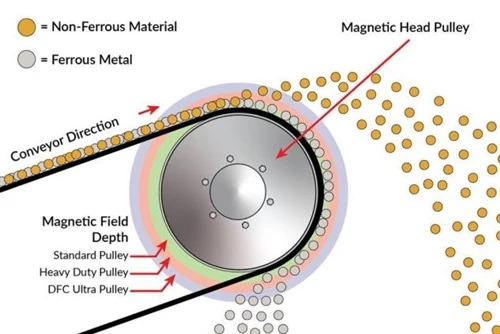
When material reaches the head pulley, non-magnetic material normally leaves the belt and follows its natural discharge path. Ferrous metal stays attracted to the belt as it moves around the magnetic pulley.
As the belt moves away from the magnetic field, the captured metal is released into a separate collection area.
The magnetic arc, or the area where the pulley provides magnetic attraction, affects how long the metal stays on the belt. If the release point is poorly matched to your conveyor layout, metal may fall back into the clean material.
Check both discharge paths to make sure they remain separate.
Splitter and Discharge Chute Design
A splitter divides the clean material from the captured ferrous metal. Its position is important because the two materials may leave the conveyor at different angles.
When checking your discharge layout, consider:
- Splitter position: Place it between the two discharge paths without blocking either material flow.
- Discharge chute: Provide enough space for clean material and separated metal to exit without buildup.
- Material trajectory: Consider how belt speed and material flow affect where materials land.
- Access for cleaning: Make sure you can reach the discharge area to remove buildup or clear blockages.
You may need to adjust the splitter position during testing, especially when your conveyor handles materials of different sizes or weights.
A suitable discharge layout helps the magnetic pulley remove ferrous metal without allowing it to mix back into your main material stream.
How to Choose a Magnetic Pulley Model
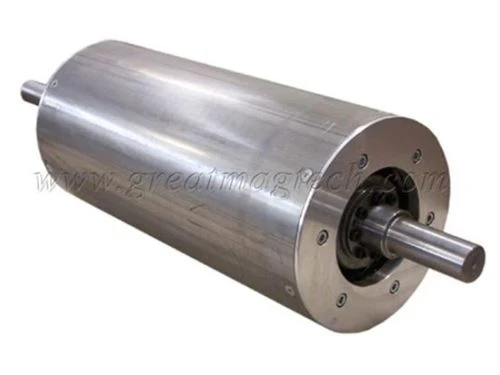
Once you've confirmed your conveyor requirements, you can compare them with the available magnetic pulley models. Great Magtech's MP series includes different pulley sizes and shaft configurations for conveyor systems.
Choose Between Full Magnetic and Half Magnetic Designs
You may also need to choose between a full magnetic design and a half magnetic design. The main difference is the coverage of the magnetic field around the rotating drum.
- Full magnetic design: The magnetic system provides magnetic coverage around the pulley and can be used when you need a continuous magnetic working area.
- Half magnetic design: The magnetic system covers about 180° of the drum, while the remaining section is non-magnetic. This creates a defined magnetic zone for capture and a non-magnetic zone for release.
Your choice should depend on the conveyor layout, material flow, and required separation path. You should also consider where the ferrous material needs to leave the belt and how much space you have around the pulley.
If you're not sure which design fits your conveyor, compare the magnetic coverage and discharge path with your actual conveyor layout before selecting the final model.
Review Great Magtech MP Series Specifications
Start by checking the dimensions in the MP series specification table. Here are a few models to help you compare the available sizes.
The MP series specification table lists pulley dimensions using A, B, C, and D. "Dia" means diameter. You can use the matching product drawing to identify each measurement
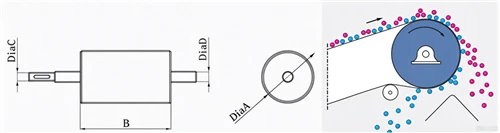
| Model | Dia A (mm) | B (mm) | Dia D (mm) | Dia C (mm) | Weight (kg) |
| MP2030 | 200 | 350 | 40 | 30 | 33 |
| MP2040 | 200 | 450 | 40 | 30 | 42 |
| MP3030 | 300 | 350 | 50 | 40 | 74 |
| MP3040 | 300 | 450 | 50 | 40 | 95 |
| MP4030 | 400 | 350 | 60 | 50 | 131 |
When comparing MP series models, check all dimensions shown in the product drawing, including Dia A, B, Dia C, and Dia D. For example, MP2030 and MP2040 share the same pulley diameter and C/D dimensions but have different B dimensions. Moving from the MP20 to the MP30 series also changes the listed pulley and shaft-related dimensions.
These specifications help you narrow down your options. You should still confirm the bearing arrangement, shaft connections, and operating loads before choosing a model.
Standard Models vs. Custom Magnetic Pulleys
If a standard MP model matches your conveyor requirements, you can use it as the starting point for your selection.
If your equipment needs a different configuration, Great Magtech offers custom magnetic pulley options, including:
- Shaft design: Custom shaft ends to fit your existing bearings or drive connections.
- Magnet type: Ferrite or rare earth magnets based on your separation needs.
- Housing material: 304 or 316L stainless steel for different operating conditions.
- Magnetic circuit: Axial or radial pole arrangements, subject to your application requirements.
For OEM equipment or conveyor upgrades, you can send your existing pulley drawing and operating requirements for review. This helps you confirm which dimensions and configurations need to change.
You can compare available models and request technical advice through Great Magtech's magnetic pulley product line.
What Information Do You Need Before Ordering?
Once you've narrowed down your magnetic pulley options, prepare the details your supplier needs to confirm the final design. This is especially useful if you're replacing an existing head pulley or ordering a custom model.
| Required Information | What You Should Provide |
| Conveyor Drawing | Existing pulley drawings or conveyor layout |
| Belt Specifications | Belt width, thickness, and operating speed |
| Pulley Dimensions | Diameter, face width, shaft size, and bearing positions |
| Mechanical Load | Belt tension, drive requirements, and operating conditions |
| Material Details | Material type, particle size, and hourly throughput |
| Metal Contaminants | Type, size, and amount of ferrous metal to remove |
| Working Environment | Temperature, moisture, dust, and abrasive conditions |
| Order Requirements | Quantity, custom features, and delivery expectations |
If you're replacing an existing pulley, include its drawing or photos with key dimensions. For a new conveyor, share your proposed layout. You can then confirm the final configuration with your supplier before placing an order.
Conclusion
Choosing the right magnetic pulley means finding a balance between conveyor compatibility and effective metal separation. You need a pulley that fits your equipment, handles the operating load, and captures ferrous contaminants under your actual working conditions.
Before making your decision, check the pulley dimensions, magnetic strength, and discharge layout. Comparing these details early can help you avoid installation problems and poor separation results.
If you're unsure which model fits your conveyor, you can share your conveyor drawings and material requirements with the Great Magtech team to get help selecting a standard or custom magnetic pulley.
FAQ
Q: Can a Magnetic Pulley Replace a Standard Conveyor Head Pulley?
A: Yes, you can replace a standard head pulley with a magnetic pulley if the dimensions and mechanical requirements match. You need to check the pulley diameter, shaft size, bearing positions, belt tension, and drive connections. You should also make sure there is enough space for separate metal discharge.
Q: Is a Stronger Magnetic Pulley Always Better?
A: No. A stronger magnetic pulley does not always give you better separation results. You need to consider the size of the metal contaminants, belt thickness, and material layer depth. A higher Gauss rating may offer little benefit if the magnetic field cannot reach the metal effectively.
Q: Can a Magnetic Pulley Remove Stainless Steel?
A: You can remove some stainless steel particles with a magnetic pulley, but not all types. Ferritic and martensitic stainless steels are generally magnetic, while austenitic grades such as 304 and 316 are usually weakly magnetic or non-magnetic. Cold working can make some austenitic stainless steels more magnetic. If you're unsure, test a sample of your material before choosing a pulley.
Q: Can a Magnetic Pulley Work on a High-Speed Conveyor?
A: Yes, but you need to confirm that the pulley can handle your conveyor's operating speed and mechanical load. At higher speeds, metal has less time to respond to the magnetic field, and the discharge path may change. You may need a different magnetic configuration or discharge setup to maintain effective separation.
Q: How Can You Test Magnetic Pulley Separation Performance?
A: You can test separation performance by running a known amount of material containing representative ferrous contaminants through your conveyor. Measure how much metal the pulley captures and how much remains in the discharged material. You should also check whether clean material is carried into the metal collection area. Testing under normal operating conditions gives you a better picture of how the pulley will perform.