










































Why People Often Worry About Magnets Near Batteries
Many people wonder whether a magnet placed close to a battery might cause it to drain, weaken, or overheat. This concern is common because modern devices, such as phones, watches, speakers, bike lights, and power tools, often contain both magnets and batteries in proximity. Understanding how they interact can help prevent incorrect assumptions and improve safety awareness.
In most everyday cases, magnets do not interfere with battery chemistry or cause harmful reactions, but certain physical situations can still require attention.
Batteries and magnets can be placed next to each other without affecting each other.
This statement is true for almost all common household and industrial situations. Batteries operate through internal chemical reactions, while magnets exert influence through external magnetic fields. These two mechanisms rarely overlap in a way that causes interference. For this reason, putting a magnet near lithium coin cells or phone batteries does not cause loss of charge or damage.
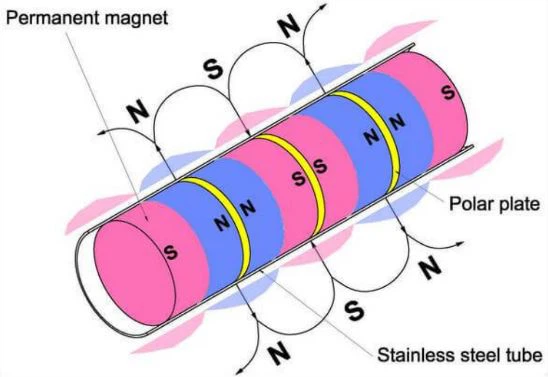
Because the battery is a device that converts chemical energy into electrical energy, the inside of the battery's metal casing is an acid solution and a carbon rod, and a chemical reaction takes place inside. The magnets are usually alloys containing iron, cobalt, and nickel, and the atoms in them are arranged in a direction, and the directions of the small magnetic moments are the same, showing a relatively obvious magnetism on the whole. The magnetism of the magnet does not affect the chemical reaction inside the battery, and the chemical reaction inside the battery and the charge at the pole distance set will not affect the magnet either.
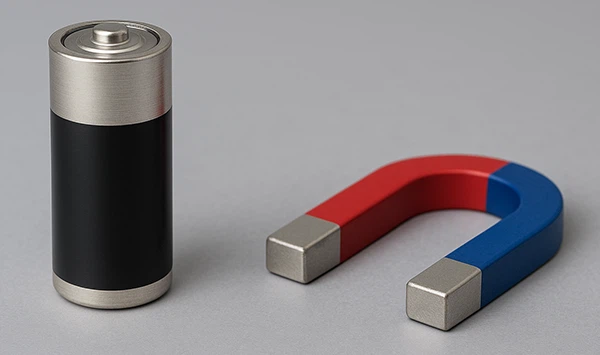
This explanation highlights the key scientific principle: The chemistry inside a battery and the physics of magnetism are independent processes. A permanent magnet won't disrupt a battery's internal electrochemical reactions, and the weak electric fields within a battery simply cannot rearrange the magnetic alignment of a magnet.
That's why even powerful neodymium magnets, like those used in tools and industrial equipment, typically do not affect the performance of standard consumer or industrial batteries.

Of course, if your watch battery contains iron, as a rule of thumb, the battery will collect around any magnets (if the battery is exposed to magnets). Batteries may drain due to contact with each other, not due to the magnets they sit on.
It all comes down to simple physical attraction, not some complex chemical or magnetic effect. What happens is this: a strong magnet can pull loose batteries together. If they connect metal-on-metal, their positive and negative terminals can touch. This creates a short circuit, allowing power to drain rapidly. The magnet isn't mysteriously "sucking" energy from the battery; it's just creating the conditions for an accidental discharge.
The fix is straightforward. Always store small button cells or any spare batteries in a way that keeps their terminals from touching. A bit of tape, the original packaging, or separate compartments in a storage case will prevent this kind of unwanted power drain.
Understanding the Relationship Between Magnetism and Electricity
Magnets and electricity are connected through fundamental physics, but the conditions needed for one to affect the other are specific. Batteries sitting still next to a permanent magnet do not meet these conditions. Only changing magnetic fields, coiled wires, or moving conductors generate significant interaction.
According to Ampere's Law, electricity and magnetism are closely related: this is the law of physics that describes how an electromagnet is created by passing an electric current through another wire to create an electric field. The reverse is also possible. Magnetic fields can also induce a current through induction that can drain the battery of any electronic device.
Ampere's Law correctly explains why electric motors, transformers, and generators function. However, these situations involve coils of wire, alternating currents, or moving magnetic fields, none of which occur in a standard stationary battery.
Therefore, while the principles are scientifically accurate, they do not apply to common situations where a permanent magnet simply sits near a battery.
But while every current can produce a magnetic field, according to Faraday's law, only a change in the magnetic force, also known as "flux," can produce a current.
This is an important clarification. A static magnet does not produce changing flux, so it cannot induce current in a battery. Only when the magnetic field changes rapidly, such as in rotating machinery, could induction occur. In everyday use, the magnetic field from a permanent magnet is not dynamic enough to create a measurable electrical effect in a battery.
The static magnetic field can only cause the battery to drain for a second, which is not enough to cause any noticeable effect on the battery.
Even if a momentary flux change were to occur when the magnet moves, any induced current would be extremely small and momentary, far below the level required to affect battery capacity or health.
Practical Safety Tips for Using Magnets Near Batteries
Even though magnets do not damage batteries chemically, good handling practices ensure safety:
Avoid letting a magnet pull multiple batteries together, which can cause short circuits.
Keep very strong magnets away from fragile electronic sensors or compasses.
Do not store powerful neodymium magnets loose in the same box as unprotected batteries.
Inspect batteries for dents if they were accidentally attracted to a strong magnet.
These guidelines focus on preventing mechanical risks, not chemical ones.
To be on the safe side, you may want to store the two separately.
This is solid advice, especially for strong rare-earth magnets. Keeping magnets and batteries apart reduces the chance of physical damage, accidental discharge, or problems caused by batteries snapping together.
FAQs
Q: Do magnets affect the lifespan of rechargeable batteries over time?
A: No. Rechargeable battery lifespan is determined by charge cycles, temperature, storage habits, and overall usage-not by magnetic exposure. A magnet does not accelerate aging or cause capacity loss in the long term.
Q: Will a magnet damage a phone battery?
A: Magnets may affect compass sensors, but they do not harm the battery itself.
Q: Do magnets affect AA or AAA batteries?
A: No. Their internal chemical reactions are unaffected by magnetic fields.
Q: Should industrial magnets be kept away from batteries?
A: Only strong magnets pose mechanical risks. Standard magnets are safe.
Conclusion
The bottom line is that magnets and batteries can be used together safely. Since their core functions, a battery's internal chemical reaction and a magnet's steady field, operate independently, they don't disrupt each other. If you store them sensibly and have a basic grasp of how batteries work, you can use both without any surprises.