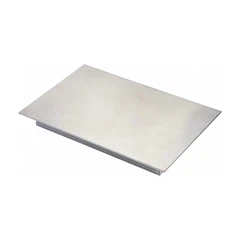
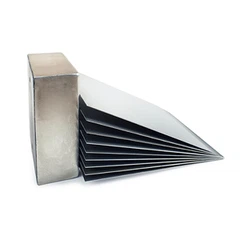

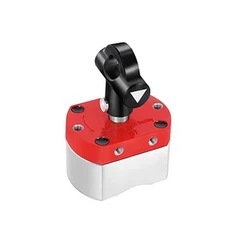

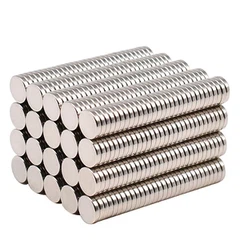
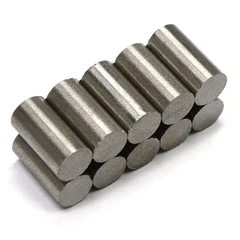
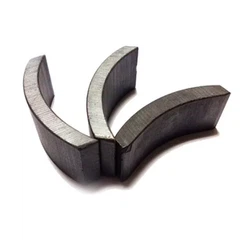
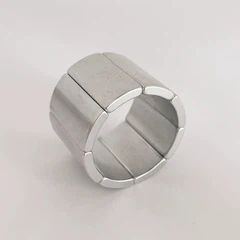

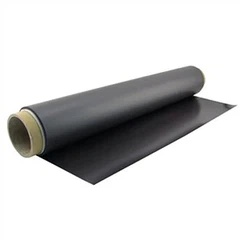




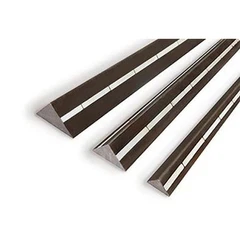


There are three main categories of magnetic tiles according to their raw materials:
①Ferrite magnetic tile ②NdFeB magnetic tile ③AlNiCo magnetic tile
1. The purpose of magnetic tile:
Magnetic tiles are mainly used in permanent magnet DC motors, which are different from electromagnetic motors that generate magnetic potential sources through excitation coils. Permanent magnet motors use permanent magnet materials to generate constant magnetic potential sources. The permanent magnet magnetic tile has many advantages instead of electric excitation, which can make the motor simple in structure, convenient in maintenance, light in weight, small in size, reliable in use, less copper consumption, low copper consumption, and low energy consumption.
The influence of the performance of the magnetic tile on the motor:
(1) High residual magnetic induction intensity Br can ensure that the motor has a high speed, large output torque, and large power. The motor will have higher efficiency.
(2) High Hcb can ensure the electromotive force required by the motor output, make the motor operating point close to the maximum magnetic energy product, and make full use of the ability of the magnet.
(3) High Hcj can ensure that the motor has strong anti-overload demagnetization and anti-aging, anti-low temperature capabilities.
(4) High (BH)max. The higher the (BH)max, the better the actual working coefficient of the permanent magnet ferrite in the motor.
(5) The larger the magnetic energy, the better, which will greatly improve the working efficiency of the motor.
(6) The better the squareness of the demagnetization curve, the smaller the dynamic loss of the motor.
(7) The higher the resistivity of the permanent magnet ferrite, the smaller the sweat loss.
(8) The temperature coefficient of permanent magnet ferrite is small, and it has good temperature stability at high temperature
Fourth, the development of the magnetic tile changes according to the needs of the permanent magnet motor itself.
Permanent magnet motors are divided into permanent magnet DC motors and permanent magnet AC motors.
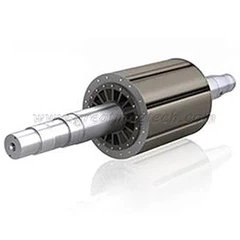
1. Permanent magnet AC motor refers to a multi-phase synchronous motor with a permanent magnet rotor, mainly using ferrite and AlNiCo magnetic tiles. Low can not meet the requirements, and now NdFeB magnetic tiles are widely used in the field of high-power synchronous motors and generators. Of course, due to the precious rare earth resources of NdFeB magnetic tiles, the price of raw materials has doubled, and its manufacturing cost and product price will continue to increase in the future, which will affect its large-scale use in some low-end fields. The NdFeB magnet itself has poor high-temperature resistance, which limits its application in high-temperature occasions.
2. Permanent magnet DC motors are further divided into brushless motors and ordinary DC motors with commutators. Judging from the shape of the magnet and the number of poles, its applications are mostly 2-pole and 4-pole among ordinary DC motors, and the magnetic tile Basically, it is used as a motor stator. Most of the miniature DC motors use ferrite magnetic tiles, which are mainly used in the fields of toys, home appliances, and automobiles. When a brushless motor uses a magnetic tile as a stator, it generally exceeds 6 poles, so its central angle is much smaller than that of an ordinary DC motor. However, when the magnetic tile is used as the rotor of the brushless motor, it can have more than 4 poles. For 4 poles, the outer surface of the rotor is magnetized, and since the central angle is close to 90° to form a circle, this can be distinguished. for ordinary DC motors.
3. Magnetic tiles have different requirements for performance and magnetic field waveform according to different application fields.
Fifth, is the production process. Depending on the material and type of magnetic tile, the craftsmanship is also very different.
Ferrite magnetic tiles are mainly sintered ferrite, and NdFeB magnetic tiles are divided into two types: sintered and bonded.
1. Introduce the process of wet pressing the opposite sex

The wet pressing process flow is raw material---pre-burning and coarse crushing (secondary ball milling)---batching secondary ball milling (wet milling)---magnetic field forming---sintering grinding---cleaning---magnetization. Because the molding slurry contains moisture, the molding particles in the magnetic field are easy to turn, so a higher degree of orientation can be obtained than dry pressing, and its performance is also higher.
2. Sintered NdFeB magnetic tile: batching---melting---breaking brick powder magnetic field forming---isostatic pressing---vacuum sintering and tempering---wire cutting and other processing---electroplating--- -Magnetizing