













Do you have such doubts: "In the detection of strong magnet Nd-Fe-B meter magnet, the same magnet, with different Gaussian meters detection, why the measured magnet is different? Why is the surface magnetism different when measuring the same part of the same magnet with the same Gaussian meter? Have you ever encountered such a problem? Follow Xiaobian to see it!
Table magnetism: As the name implies, "magnetic field intensity induced on the surface of magnet", the unit is Gauss (Gs). People who haven't bought strong magnet NdFeB think it's "magnetism of watch" by Wang Wenshengyi.
The surface magnetism of different parts of the same strong magnet Nd-Fe-B is different. The surface magnetism of the magnetic pole position of the magnet is the highest value, and the position of the magnetic pole is also the center point of the magnet surface, so we generally detect the "central surface magnetism".
Hall-effect Gauss gauge (or Tesla gauge) is usually used to measure the magnetism of the magnetometer.
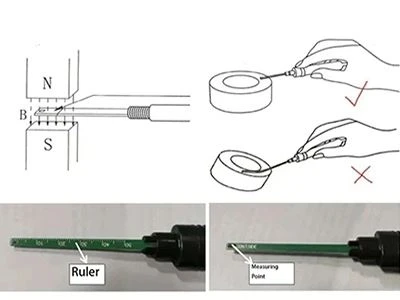
Therefore, in order to accurately measure the surface magnetism of Nd-Fe-B magnet, we still need to standardize some things, such as: using diagonal intersection point to find the center of magnet, using the probe with base band calibration to uniformly extend the length, prescribing the use of Hall elements with uniform thickness, and so on.
1. Different manufacturers have different Hall induction components on Gauss meters, some are different in thickness and some are different in size, so the measured magnetism of gauges will inevitably be different. For example, the same magnet is measured by a Gaussian meter made in China. The Gaussian meter is 2000 GS. The Gaussian meter in Japan is 2200 GS.
2. The magnetic pole center on the surface of the Nd-Fe-B magnet can not be seen or touched. If the Hall element can not be accurately placed in the magnetic pole center, the measured surface magnetism will be different naturally.
3. The constant current depends not only on the accuracy of the components of the instrument but also on the power grid and other factors. Even if the same person uses the same Hall element, if the current through the Hall element is not constant, it will be measured differently.
4. The accurate test method is to place the probe close to the magnet surface and perpendicular to the magnetic line. However, many inspectors failed to maintain 90 degrees.