

























Magnets have magnetic force which is determined by the properties of magnets. If interpreted by atomic current, it is the magnetic field produced by current that magnetizes other objects and produces the interaction of electric field and electric field to produce force. Then magnetic force is produced.
Matter is mostly made up of molecules, molecules are made up of atoms, and atoms are made up of nuclei and electrons. Within an atom, electrons spin around and around the nucleus. Both of these movements of electrons produce magnetism. But in most substances, electrons move in different directions, and the magnet effect cancels out each other. Therefore, most of the magnets do not show magnetism under normal conditions, and there is no magnetism outside.
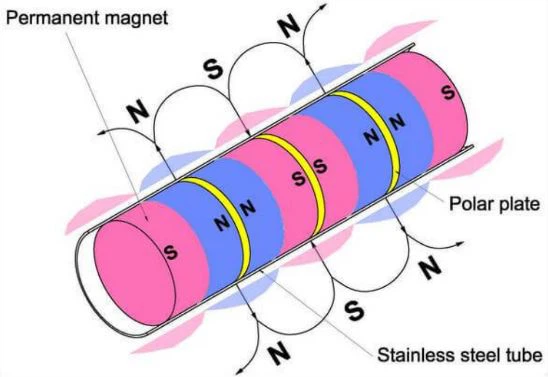
Unlike other materials such as ferrite, the spins of electrons in ferrite can be arranged spontaneously in a small range to form a spontaneous magnetization region, which is called domain. After magnetization of ferromagnetic materials, the internal magnetic domains are arranged in a neat and uniform manner, which makes the magnetism stronger and makes the magnet become a magnet. The magnet absorption process is the magnetization process of the iron block. The magnetized iron block and the magnet have attraction between different polarities, and the iron block is firmly "sticking" with the magnet. We say that the magnet is magnetic, and the magnet has magnetic force.
So that's probably how the magnetic force comes about.