









During the use of long-distance oil and gas pipelines, due to corrosion, cracks, and damage, etc., oil and gas leakage will occur. Oil and gas leakage will not only pollute the surrounding environment of long-distance pipelines but also may cause safety accidents such as combustion and explosion, resulting in huge economic losses. . Therefore, long-distance oil and gas pipelines need to be inspected regularly to ensure their safety and reliability of the pipeline.

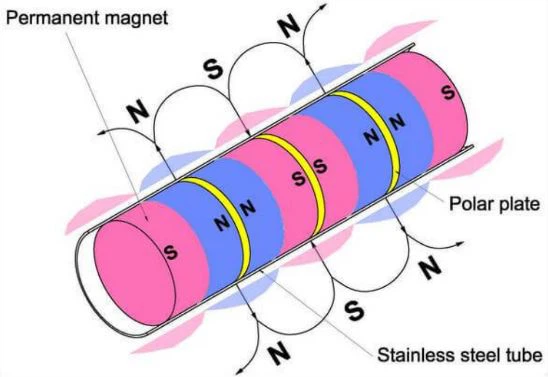
At present, the detection methods of long-distance oil and gas pipelines include the ultrasonic method, magnetic flux leakage method, and in-pipe TV camera method. In the detection of long-distance oil and gas pipelines, the magnetic flux leakage method is widely used in the detection of pipeline defects. The magnetic flux leakage method mainly relies on high-precision magnetic flux leakage, advanced signal processing, and data storage systems, and then uses ground analysis equipment to analyze the test results to obtain data on various defects and damage state parameters in the pipeline. The basic principle of pipeline magnetic flux leakage detection is: to use the permanent magnet and steel brush to apply magnetic force on the pipeline, the free end of the steel brush is in contact with the inner wall of the pipeline, and the inner wall of the pipeline is magnetized under the action of the external magnetic field. If there is no defect in the inner wall of the pipeline, the distribution of magnetic force lines is very regular; if there is a defect in the inner wall of the pipeline, it will lead to a change in the magnetic resistance, and the change in the magnetic permeability will cause the magnetic force line to bend, and a part of the magnetic force line on the inner wall of the original pipeline leaks out of the pipeline wall to form a magnetic flux leakage; after the leakage magnetic field is detected by the internal detection sensor of the pipeline Corresponding induction signals will be generated, and the induction signals will be processed and stored. Finally, the data analysis system will find out the defect location and severity of the defects in the long-distance oil and gas pipeline, so as to guide the pipeline repair construction personnel to excavate and repair the pipeline.
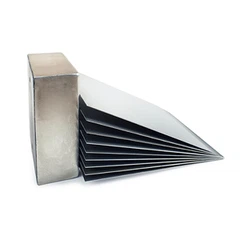
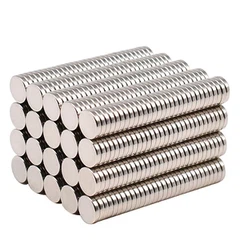
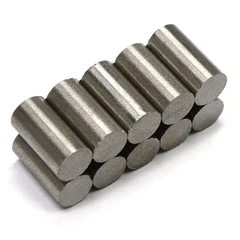
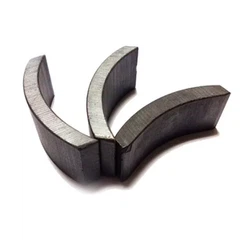
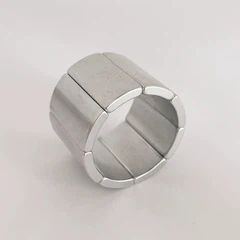
Samarium-cobalt magnets are generally used as permanent magnets in the inspection of oil and gas pipelines using the magnetic flux leakage method. SmCo magnets have magnetic properties close to that of NdFeB, can provide a strong magnetic field, have good high-temperature resistance and corrosion resistance, and are suitable for use in complex and changeable outdoor environments.