








Sintering and heat treatment
The blanks pressed by magnetic field orientation are sintered under a high vacuum or pure inert atmosphere to reach a high density close to 95% of the theoretical density. The magnet holes have a closed structure, ensuring the uniformity of the magnetic flux density and the chemical stability of the metal; because of the magnet The characteristics of permanent magnets are closely related to their metallographic microstructure. The heat treatment process after sintering is crucial to the adjustment of the magnetism. However, after all, the processing temperature is relatively low. Some important microstructural characteristics cannot be completely expected to be adjusted by heat treatment, but must be adjusted in The sintering process is carefully controlled.
To avoid the decrease in coercivity caused by the growth of the main phase grains, Nd-Fe-B magnets need to be sintered at a temperature lower than 1100°C. The usual sintering temperature is 1050~1080°C and can obtain close to zero porosity. The real density and grain size are in the range of 5~15μm; to obtain high coercivity, two-stage heat treatment near 900°C and 500°C is usually required, and quenching is required after sintering and heat treatment to fix the corresponding microstructure. structure. The optimal combination of heat treatment temperature and time is closely related to the added elements and their composition in the Nd-Fe-B magnet, but a large number of experiments show that the first-level heat treatment temperature (900°C) has wide applicability because of the rich content at this temperature. The Nd phase is in a liquid state. As a grain boundary phase, it can repair the surface of the main phase grains. As long as the time is not too long, it will not cause the main phase grains to grow too much or the Nd-rich phase to become enriched. This effect has nothing to do with the composition. Large; the second-stage heat treatment is crucial to the adjustment of the phase composition and microstructure of the magnet. In this temperature range, eutectic reactions will occur, and the total amount, composition, and distribution of the liquid phase are changing, so it will be sensitive to It affects the intrinsic coercive force of the magnet, the squareness of the demagnetization curve and the high-temperature irreversible loss of the magnet.
Machining
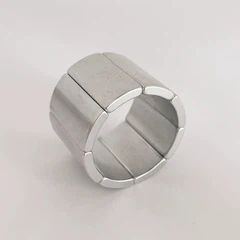
Due to the characteristics and technical limitations of the magnetic field orientation forming process, it is difficult for sintered magnets to directly achieve the shape and dimensional accuracy for practical applications at one time, so mechanical processing of sintered blanks is inevitable. The main reasons are:
1. Many finished magnets are small in size and complex in shape, and can only be processed from blank magnets of a certain shape;
2. Even for nearly-finally formed blank magnets, due to the low bulk density and poor fluidity of the powder, the filling uniformity of the female mold is poor, and it is difficult to avoid fluctuations in the shape or size of the sintered magnet blank;
3. Due to the obvious difference in sintering shrinkage of the Nd-Fe-B blank magnet in parallel and perpendicular to the orientation direction, as well as the difference in sintering shrinkage at the boundary and center of the blank magnet, it is ultimately difficult to meet the dimensional accuracy requirements of the finished magnet.
Considering raw material and labor costs, Japanese European and American companies mostly choose near-net forming technology, supplemented by subsequent mechanical processing; Chinese companies produce a wide range of rare earth permanent magnet products, mainly using a comprehensive production process that combines rough magnets with post-processing, and fully draws on ceramics And the technological advantages of crystal processing bring the mechanical processing level of rare earth permanent magnets to the extreme. With the increase in raw material cost and labor cost pressure, near-net forming and automatic forming technology are developing rapidly in our country.
Rare earth permanent magnets prepared by powder metallurgy are a typical cermet product that is hard and brittle. For hard and brittle materials, the turning, milling, planing, and grinding drills used for general machining only include cutting, drilling, and drilling. Grinded and tumbled. It can be subdivided according to the basic characteristics of the processing surface:
Blade cutting usually uses diamond or cubic boron nitride powder electroplated blades. Different blade thicknesses and blade edge positions are selected according to the incision depth and geometric tolerance requirements. The edge of the inner circular cutter is supported by the blade and the outer circular hoop. Good flatness can be ensured during the cutting process, so the blade thickness can be as high as 0.1mm, but the depth of the cut and the size of the magnet being cut is limited by the difference between the inner diameter of the blade and the inner and outer diameters. The cutting edge of the external cutter floats on the outer edge, and the blade support ability is inferior to that of the internal cutter. Therefore, to ensure the same tolerance level, a slightly thicker blade is required, generally in the range of 0.2~0.5mm, and the resulting material loss is also Bigger. For products with large batches and single sizes, it is very efficient to use wire saws for slicing.
Electrical discharge cutting and laser cutting are direct thermal processing, which can be used for cutting with complex shapes. However, the cutting efficiency is relatively low and the processing cost is high. Moreover, some studies have found that the processed surface of sintered NdFeB magnets has a thickness of about 10% due to the heating process. The 15μm Nd-rich layer reduces the chemical stability of the material.
Magnet drilling relies on diamond drills or lasers. To improve material utilization, the technology of hollow drilling has been developed. The solid cylinder dug out from the center of larger inner diameter products can also be used to make other small-sized products. Drilling with ultrasonic action The hole pattern can alleviate brittle damage, which is beneficial to the processing of high-performance or high thermal stability magnets with high brittleness.
There are two types of grinding wheels: metal-based or resin-based. Profile grinding makes a grinding wheel base based on the grinding surface profile, which is then coated with diamond or BN powder and modified to meet the final product requirements.
Mechanical processing will produce defects on the surface of the magnet, which seriously affects the performance and corrosion resistance of the magnet. This is more serious for small and thin products, so it needs to be repaired by removing or repairing the surface defect layer.