

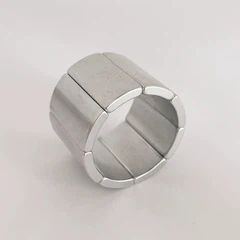




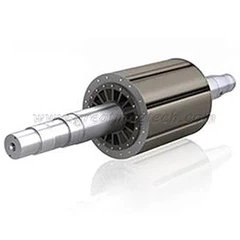



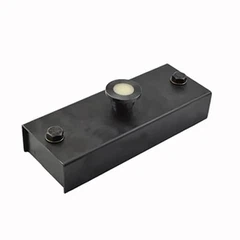
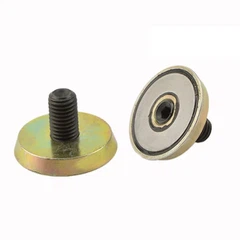
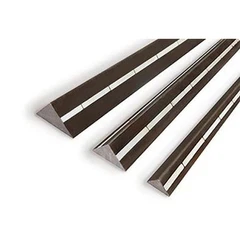



Superconducting magnet refers to a general term for superconducting coils and their cryogenic containers. Superconducting magnets are the most important core components of superconducting suspension railways. The propulsion, suspension and guidance forces of the vehicle are all generated by superconducting coils. Like permanent magnets, superconducting magnets can provide a stable magnetic field, and superconducting magnets can also provide high-intensity magnetic fields that ordinary permanent magnets cannot provide, which is why maglev railways use superconducting magnets. Due to the development of high-temperature superconductors, superconductivity occurs at liquid nitrogen temperature (78K), which greatly improves the performance of superconducting materials. However, as the superconducting material used in the maglev railway, the critical current of the high-temperature superconducting material under the high-intensity magnetic field cannot meet the requirements.
At 8:00 on September 19, 2007, the Beijing Spectrometer Superconducting Magnet of the Large Particle Detector Beijing Spectrometer successfully reached 10,000 Gauss (20,000 times the Earth's magnetic field), and the current reached 3,368 amperes, the maximum current of 3368 amperes. The energy storage reaches 10 million joules, reaching the design goal. The superconducting magnet was independently developed by the Institute of High Energy Physics, Chinese Academy of Sciences. It is one of the key components of the Beijing Spectrometer, mainly including superconducting coils, cryostats, cold matter and electromagnetic force suspension support structures and valve boxes.
For an electromagnet with an iron core, it is quite difficult to obtain a flux density higher than 2 (Tesla) (magnetic field of 1.6X10' Amp/m). If a hollow solenoid with a superconducting coil is used, a high magnetic flux density of about 3 to 15 (Tesla) can be obtained. The device is mainly used for research work, such as hydrogen cloud chamber, MHD power generation, electron microscopy, nuclear magnetic resonance, enclosed plasma (nuclear fusion power generation), etc. If the train reaches a speed of 500 kilometers per hour, a magnetic levitation method can be used to suspend the train off the ground. As long as it is driven once, the train can move forward continuously. The key to achieving this is the use of superconducting magnets.
(1) The current transmission resistance in the superconducting magnet coil is zero, which can conduct strong currents that cannot be conducted by ordinary wires;
(2) It can generate a strong magnetic field of up to ten Tesla, which is extremely beneficial to greatly improve the sensitivity and resolution of the nuclear magnetic resonance spectrometer. At the same time, the uniformity and stability of the magnetic field are also very good, which is very suitable for modern spectrometers. magnet;
(3) The field strength is high and stable and uniform. At present, the superconducting magnet spectrometer is generally around 200N~00MG, and the maximum can reach 600MG.