


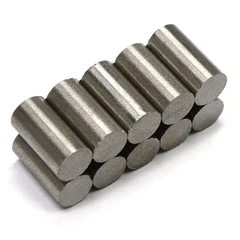
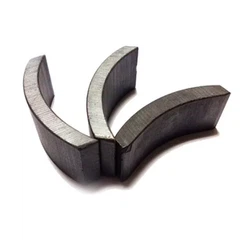
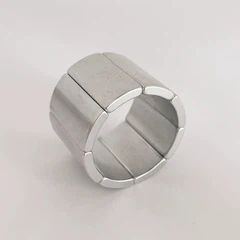
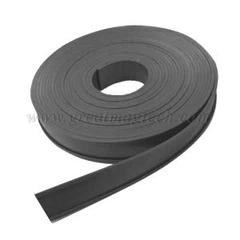


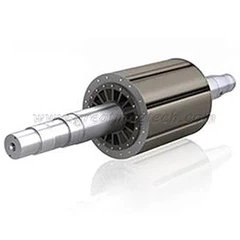


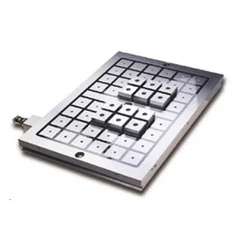


In motor magnets, AlNiCo permanent magnet material is the earliest and most widely used permanent magnet material, and its preparation technology and process are relatively mature. Now there are factories in Japan, the United States, Europe, Russia, and China. Among the large-scale production enterprises, Hangzhou's permanent magnet output currently ranks first in China, with an annual production capacity of 3,000 tons.
Permanent magnet ferrite material: In the 1950s, ferrite began to flourish. Especially in the 1970s, strontium ferrite with good performance in coercivity and magnetic energy was mass-produced, and the use of permanent magnet ferrite expanded rapidly. As a non-metallic magnetic material, ferrite is popular because of its easy oxidation, low Curie temperature, and high cost of metal permanent magnet materials.
Samarium cobalt material: A permanent magnet material with excellent magnetic properties that emerged in the mid-1960s, with very stable performance. Samarium cobalt is particularly suitable for the manufacture of motors in terms of magnetic properties, but due to its high price, it is mainly used in the research and development of military motors such as aviation, aerospace, weapons, and high-tech motors where high performance and price are not the main factor.
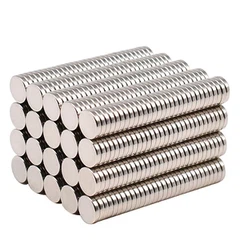
NdFeB material (NdFeB magnetic material is an alloy of neodymium, iron oxide, etc., also known as magnetic steel. It has extremely high magnetic energy product and coercive force, and the advantages of high energy density make NdFeB permanent magnet materials in It has been widely used in modern industry and electronic technology, making it possible to miniaturize, lighten, and thin equipment such as instruments, electroacoustic motors, and magnetic separation magnetization. Because it contains a lot of neodymium and iron, it is easy to rust. Chemical passivation is one of the better solutions at present.
Ferromagnetic materials commonly used in motor magnets are generally divided into non-ferromagnetic materials and ferromagnetic materials according to their magnetic permeability. Due to the low permeability of non-ferromagnetic materials, it exhibits non-permeability of air, copper, aluminum, insulating materials, etc., while the permeability of ferromagnetic materials is high, showing the good performance of iron, nickel, cobalt, their alloys, etc. magnetic permeability. It is to generate a strong magnetic field in the motor through a certain excitation magnetomotive force. The magnetic circuit is mostly made of ferromagnetic material with high permeability.
The magnetization of the motor magnet material means that under the action of a magnetic field applied to the ferromagnetic material, the magnetic field in the material is significantly enhanced, showing a strong magnetic field, which is magnetized by the ferromagnetic material. Ferromagnetic bodies can be magnetized because there are many small magnet-like magnetic domains inside. The magnetic domains are represented by small magnetic magnets, the material is not affected by the external magnetic field, the magnetic domains are chaotically discharged, and their magnetic effects cancel each other out, and the outside does not show magnetism. Once subjected to the action of an external magnetic field, the magnetic domain will resist the rotational frictional resistance, and the magnetic axis will rotate in unison, thereby forming an additional magnetic field, which is superimposed on the external magnetic field, and the resultant magnetic field is greatly enhanced. It is shown that because the internal structure of non-ferromagnetic materials has no magnetic domain and no magnetization phenomenon, under the same magnetic field, the magnetic field excited by ferromagnetic materials is stronger than that of non-ferromagnetic materials, and the permeability of ferromagnetic materials is higher than that of non-ferromagnetic materials. Magnetic materials are much larger.