


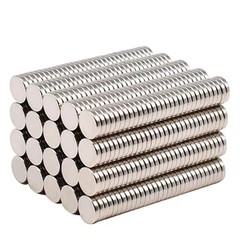
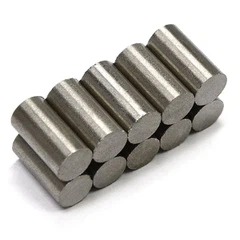
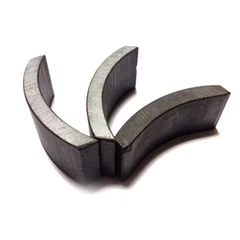
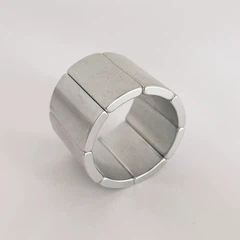


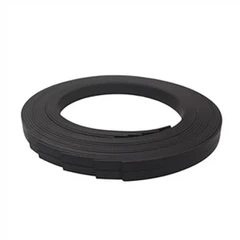







NdFeB magnet: NdFeB magnet is an object that attracts iron and generates a magnetic field outside it. The narrow NdFeB magnet refers to the finished product of NdFeB magnet ore. The generalized NdFeB magnet refers to an object or assembly used to generate a magnetic field. The neodymium iron boron magnet of the neodymium iron boron magnet acts as a magnetic dipole and can attract ferromagnetic substances such as metals such as iron, nickel and cobalt. The determination of the magnetic pole is to suspend a neodymium iron boron magnet with a thin wire. The magnetic pole pointing to the north is called the north pole or the north pole, and the magnetic pole pointing to the south is the guide pole or the S pole. (If the Earth is thought of as a large iron-boron magnet, the earth's geomagnetic North Pole is the S-pole, and the geomagnetic South Pole is the N-pole.) The NdFeB magnets are attracted by the opposite poles and the same poles are repelled. The guide is extremely attracted to the North Pole, and the guide is extremely repulsive to the guide, referring to the repelling of the North Pole and the North Pole.
NdFeB magnets: NdFeB magnets are classified as Yongshi NdFeB magnets and non-Yongshi NdFeB magnets. The natural eternal neodymium iron boron magnet is also called a natural magnet, and the eternal neodymium iron boron magnet can also be made by hand (the strongest neodymium iron boron magnet is neodymium iron boron magnet). Non-permanent neodymium iron boron magnets are magnetic only under certain conditions, usually in the form of electric neodymium iron boron magnets, that is, current is used to strengthen the magnetic field. The magnetic molecules inside the unmagnetized magnet (the molecular NdFeB magnet theory) are randomly arranged, and the magnetic molecules will be regularly arranged after the magnetization process. At this time, the N pole and the S pole of the magnetic molecule are magnetically oriented in the same direction to form a neodymium iron boron magnet. At the same time, there are opposite poles on the unified NdFeB magnet and the magnetic quantities of the two poles are commensurate.